Web 2026-08-14
What fourteen years of our own websites taught us about other people's
Every version of our site is in the public archive, mistakes included. Here is what we would tell a client about to make each of them.
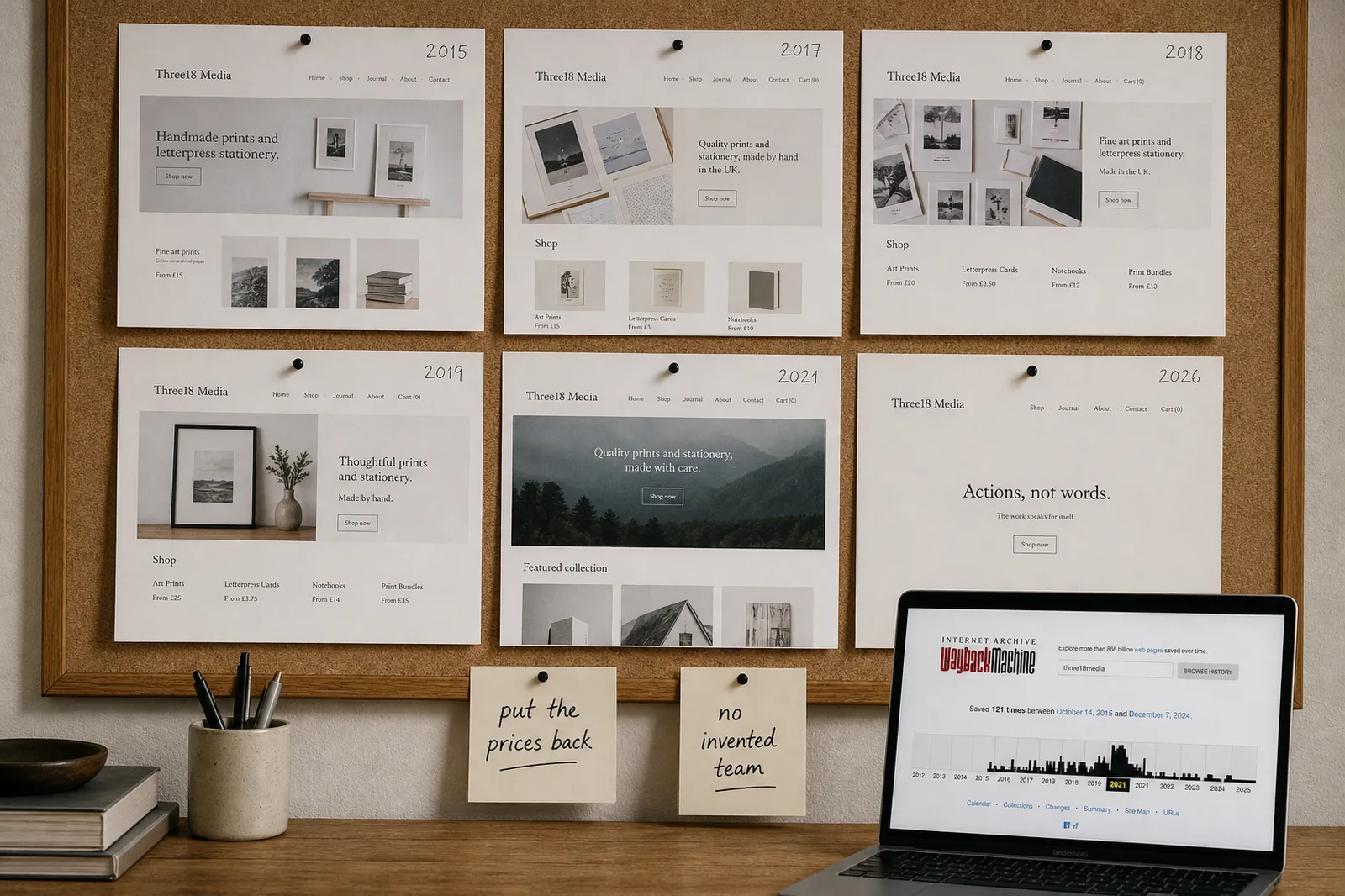
Every website this studio has ever had is sitting in the Internet Archive, and anyone can look at it. That is uncomfortable, and it is also the most useful case study we have, because we know exactly what each version was trying to do and whether it worked.
The first one, in 2015, was a Weebly page. It sold our own products alongside design work: invitations, framed prints, stationery, two small product lines of our own. It was not sophisticated and it was not designed to be found. What it got right was that it sold things, and it taught us more about pricing in eighteen months than the next three years of client work did. If you are a founder deciding whether your first site needs to be good, the honest answer is that it needs to transact. Nothing else is close.
The second one, from 2017 to 2019, was the most commercially competent site we have ever run, and it looked worse than the one that replaced it. Every service had a price on it. There were interest free payment plans. Six months of hosting came with every website. Those three things did more qualifying work than any amount of copy, because a prospect who reached the contact form had already decided they could afford us. We removed all of it during a rebuild, on the reasoning that pricing publicly was limiting. Enquiry volume went up and the proportion worth having went down. That is not a coincidence and it took us far too long to admit it.
The same site also called us a premier agency with superstar developers, on every page, in the title tag. It is embarrassing to read now. The tell is that none of it was checkable. A claim that cannot be verified is not a claim, it is a noise, and prospects have learned to hear it as one.
The third one, in 2021, is the cautionary tale. We bought a theme, populated it with the demo content while we waited for the real material, and then got busy. It sat live for months with eight fictional team members on it, complete with photographs and biographies of people who did not exist. Nobody did that deliberately. It happens because placeholder content that looks finished removes the pressure to finish it.
That is the reason this site marks unwritten content in brackets and refuses to invent a substitute. A missing name is honest and slightly annoying, which is exactly the right amount of annoying to make somebody go and find the real one.
The rules we now work to came out of those three sites rather than a strategy day. No number without the basis it was measured on. No service without a price. No case study without a named client. No award without a name and a year. No testimonial without a full attribution. And a published list of when not to hire us, because the 2018 site would have sold to anybody and some of those projects cost us more than they earned.
Written by Shane Powell